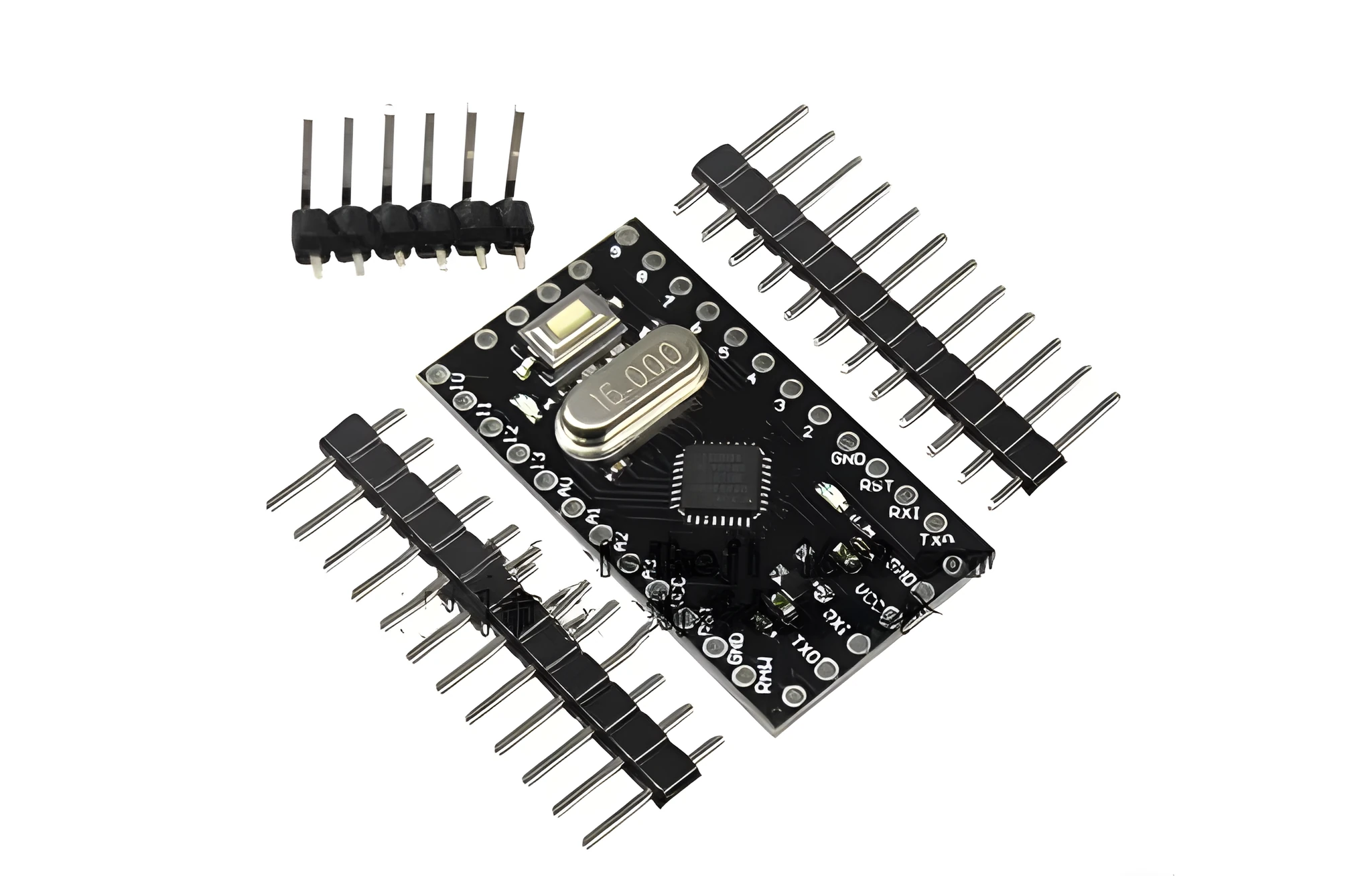
Electronic building block template microcontroller board Mini Pro with ATMEGA328P-AU chip 33.3mm by 18.0mm dimensions featuring 14 digital I/O ports 6 PWM outputs 8 analog inputs 16MHz clock speed and support for 3.3V to 12V DC external power


Electronic building block template microcontroller board Mini Pro with ATMEGA328P-AU chip 33.3mm by 18.0mm dimensions featuring 14 digital I/O ports 6 PWM outputs 8 analog inputs 16MHz clock speed and support for 3.3V to 12V DC external power
Mini Pro Electronic Building Block Template: Compact ATMEGA328P-AU Microcontroller Board with 14 Digital I/O Ports
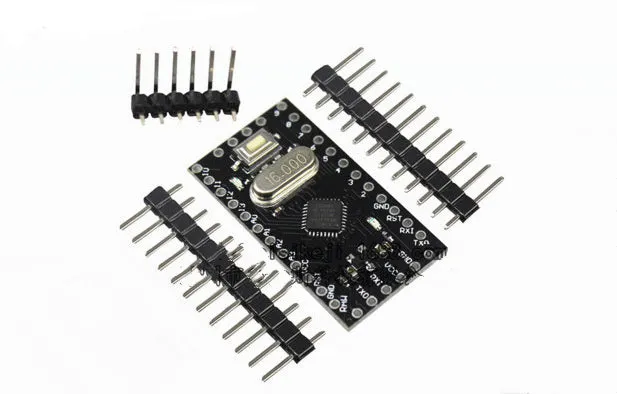
This electronic building block template, based on the professional Mini Pro version, delivers a complete microcontroller foundation for electronics projects requiring precise digital and analogue control in a minimal footprint. Designed around the established Atmel Atmega328P-AU integrated circuit, this board provides a ready-to-use core with extensive connectivity options detailed in its technical parameters. Its 33.3mm by 18.0mm size makes it suitable for space-constrained designs, while its feature set—including 14 digital input/output ports, 8 analogue inputs, and 6 configurable PWM outputs—offers versatility for interfacing with sensors, actuators, and communication modules. The board supports flexible power options from 3.3V to 12V DC and includes essential elements like a 16MHz resonator, reset button, and mounting hole pin headers, forming a practical template for custom circuit development.
Features and Construction

The board's design is defined by its technical specifications, which list exact port configurations and core components. This section breaks down its construction and the practical implications of its measured features.
Material and Build
The primary processing component is the Atmel Atmega328P-AU microcontroller, a common IC known for its use in various development boards. The circuit board itself acts as the substrate, hosting this microcontroller along with the 16MHz resonator, pin headers for all input/output ports, a reset button, and the necessary copper traces for electrical connectivity. The build includes mounting hole pin headers, which provide a method for physically securing the board to an enclosure or another surface within a larger project assembly. The construction focuses on providing the essential electronic blocks without additional, unspecified peripherals.
Size and Practical Fit
With dimensions of 33.3mm by 18.0mm, this microcontroller board presents a compact form factor. This specific measurement allows it to be integrated into projects where space is at a premium, such as within custom handheld devices, small robotics, or embedded installations. The small size does not compromise the port count, as it still offers the full complement of 14 digital and 8 analogue pins arranged along its edges. The practical fit is further aided by the mounting holes, enabling stable installation. When planning a project enclosure or PCB layout, these exact dimensions should be used to ensure proper clearance and placement.
Uses and Placement

The combination of its processing core, multiple I/O options, and compact size supports a range of applications. Its role as a 'building block template' suggests it is intended as a foundational component within larger, custom electronic systems.
Event or Professional Use
In professional prototyping, laboratory settings, or educational workshops, this board serves as a standardised microcontroller core for testing circuits, developing proof-of-concept devices, or teaching electronics principles. The specified 6 PWM outputs (on pins D3, D5, D6, D9, D10, D11) make it suitable for controlling motor speed, LED brightness, or servo position in demonstrations or functional prototypes. The availability of 8 analogue inputs (A0-A7) allows for data acquisition from multiple sensors simultaneously, useful in environmental monitoring setups or data-logging equipment. Support for an external 3.3V to 12V DC power supply, including from a 9V battery, provides flexibility for field testing or portable applications outside of a fixed laboratory power source.
Everyday Home Use
For hobbyists or makers working on home automation, custom gadgets, or interactive art projects, this board offers a centralised control unit. The digital I/O ports can interface with switches, relays, or LEDs, while the TTL-level serial port (RX/TX) enables communication with other devices like Bluetooth modules or GPS receivers for more advanced projects. The specified support for serial download means users can program the microcontroller with custom code using common development environments. Its use as a building block means it can be combined with other sensors and components to create tailored solutions like a smart plant watering system, a security sensor network, or a custom controller for model railways, leveraging its precise port configuration.
Benefits and Buying Value
The value of this product lies in its defined specification set and its role as a core, reusable component within the electronics development process.
Reuse and Low Maintenance
As a microcontroller board, its core value includes reusability across different projects. Once programmed for one task, it can be reprogrammed via serial download for a completely different application, making it a lasting component in an electronics toolkit. The low maintenance aspect stems from its solid-state construction; with no moving parts and power requirements clearly stated (3.3V-12V DC), it requires only appropriate power supply and connection. The longevity is tied to the durability of its soldered components and circuit board, though specific lifespan claims are not provided by the source material.
Why Choose This Product
Choosing this specific electronic building block template is supported by its clearly listed technical parameters. It provides a known quantity: an ATMEGA328P-AU microcontroller running at 16MHz with a precise set of 14 digital I/O ports, 8 analogue inputs, and 6 PWM outputs on identified pins. This level of detail allows for accurate project planning compared to more generic, unspecified boards. The inclusion of mounting hole pin headers and a reset button adds practical utility for final assembly. For developers who require these exact specifications in a 33.3mm by 18.0mm format, this board presents a focused solution without unspecified extra features that may complicate a design or increase cost unnecessarily.